
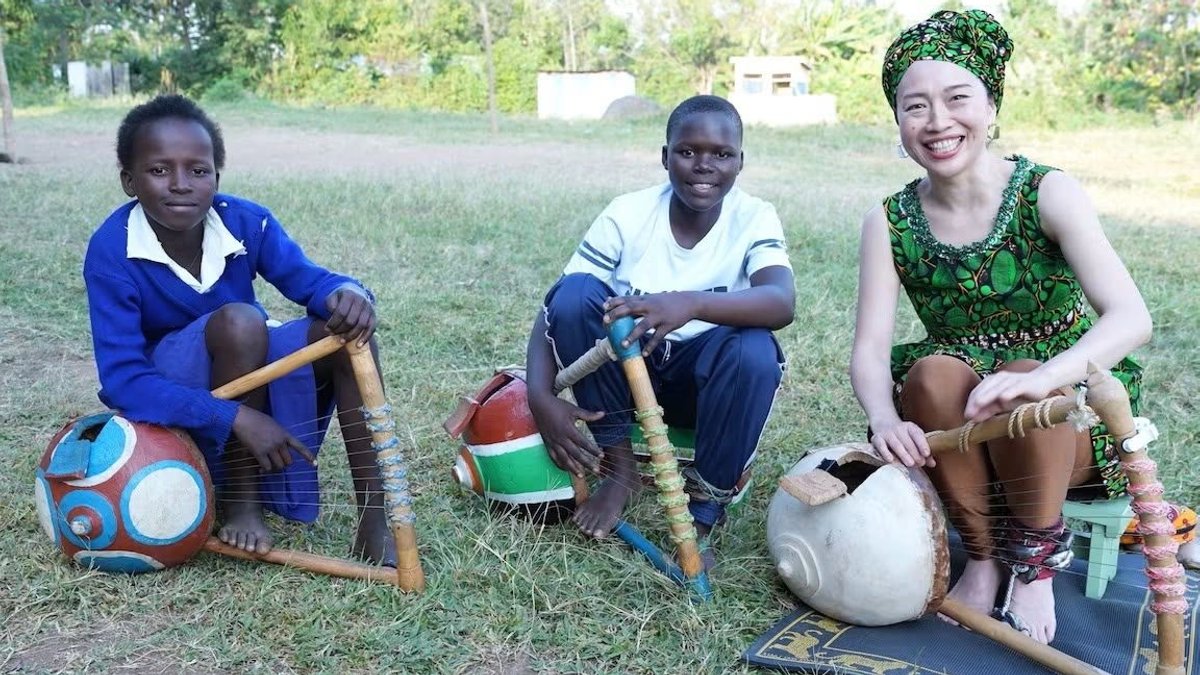
Born in Tokyo, Anyango travelled to rural Siaya after hearing the distinct sound of the nyatiti. She spent a year learning Dholuo, the Luo language, and adopting local customs. In her autobiography Anyango Nyar Siaya (Nyatiti Queen), she describes how mastering the instrument required earning the trust of the community that had kept the tradition alive for generations. Her mentor, the late nyatiti master Okumu K’Orengo, eventually accepted her as a disciple, marking the start of a career built on cultural respect.
From Tokyo to Siaya: A Path of Immersion
“Culture is our identity. Without identity, we cannot truly live,” she says, highlighting why language matters to her. “Language is spirit. Language is history. Language is the essence. If there is no language, there is no spirit.” For Anyango, learning Dholuo was not a side note; it turned music from a skill into a lived experience. The lyrics she performs often contain concepts that lack direct translation, linking the music to land, ancestors, and community.
Related: Unveiling the Couture Revolution: Latex Leggings UK and the Eclat of Modern Fashion
Balancing Tradition and Innovation on Stage
During the evening performance, Anyango began on a low stool, playing an acoustic nyatiti before switching to a modified electric version. The shift illustrated her approach: rooted in tradition yet open to contemporary interpretation. Trained in jazz, she expands the instrument’s harmonic language through measured improvisation, adding tonal possibilities without losing the instrument’s core character.
Kenyan music producer Tabu Osusa, who has organized several of her tours, emphasizes the need for both musical and cultural literacy. He defines musical literacy as understanding rhythm, harmony, phrasing, and ensemble work, while cultural literacy involves grasping histories, languages, symbolism, and social contexts. Her playing demonstrates both, showing technical precision alongside deep knowledge of the nyatiti’s repertoire and the Luo community that sustains it.
Her performance also raised concerns about artificial intelligence in the arts. She acknowledges AI’s ability to generate melodies and imitate voices but warns that it cannot inherit the language, memory, or lived experiences that give music its identity. Technology may become another tool, yet it cannot replace the cultural knowledge that allows music to speak authentically.
In a broader sense, the link between language and music is often overlooked, yet it is central to many African traditions. Songs preserve histories that may never be written down, and instruments embody centuries of refined knowledge. When cultural context is stripped away, much of the music’s meaning disappears.
Teaching the Nyatiti Back in Japan
Today, Anyango brings African music to Japanese schools, universities, and cultural programs. She delivers performances, lectures, and workshops that echo the patience and humility she first practiced in Siaya.
Related: 3 Ways Your Company Can Use Art Management Tools to Elevate Client Experience
Each concert, whether in a hall or a classroom, reminds audiences that an instrument carries the stories, people, and generations that shaped it.
Her legacy inspires new generations.


